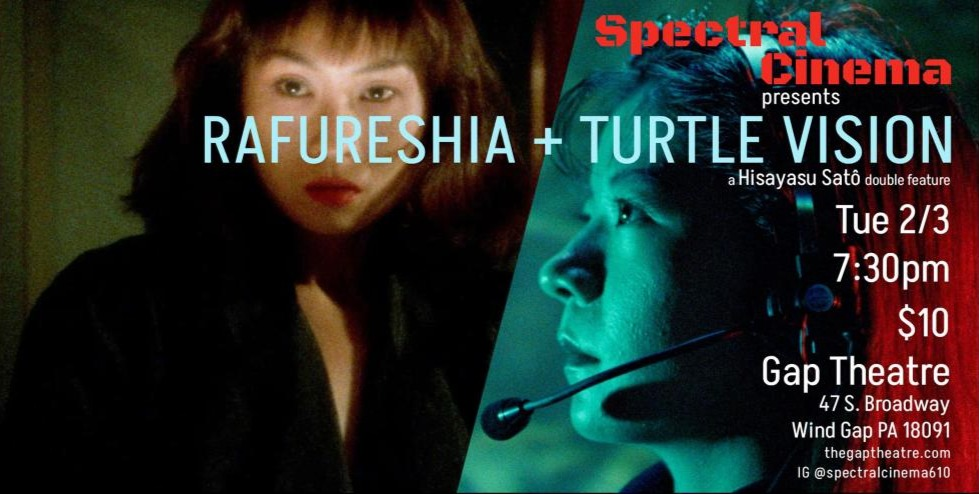
{“@context”:”http://schema.org”,”@type”:”Event”,”name”:”SPECTRAL CINEMA PRESENTS: TURTLE VISION (1991) + RAFURESHIA (1995)”,”url”:”https://www.ticketleap.events/tickets/gap-theatre/spectral-cinema-presents-turtle-vision-1991-rafureshia-1995″,”startDate”:”2026-02-03T19:30:00-0500″,”endDate”:”2026-02-03T23:30:00-0500″,”image”:”https://tlt-events.s3.amazonaws.com/80f23646-796c-4359-a933-cb74333703b8_resize.jpg”,”description”:”SPECTRAL CINEMA PRESENTS: A Hisayasu Sat? Double Feature: TURTLE VISION (1991) + RAFURESHIA (1995) Hisayasu Sato The Japanese equivalent of softcore pornography, the pink film (or pinku eiga, as it is known in Japan), may appear to the uninitiated as a dispiriting dead zone of creative aridity. Yet, like any genre framework, its rigid constraints and commercial imperatives have often proven fertile ground for formal invention and ideological provocation. Much as genre cinema’s limitations are known to foster subversion, so too has pinku eiga produced some of Japan’s most radical filmmakers. If Koji Wakamatsu stands as the mode’s most overtly political figurehead, Hisayasu Sat? (christened one of the ‘Four Heavenly Kings’ of pink cinema) emerges as its most notorious and confrontational practitioner. A filmmaker whose fixation on cinema’s voyeuristic potential borders on the pathological, Sat? has spent much of his career refining a blunt, ‘sledgehammer’ visual style, reworking a remarkably consistent set of themes while filtering them through an idiosyncratic aesthetic: a post-William Gibson cyberpunk sheen fused with a down-and-dirty, dime-store futurism that evokes the corrosive influence of J. G. Ballard. A case of doldrums inflected by Ballardian nihilism and bathed in antiseptic Listerine blues, TURTLE VISION exudes and intensifies the characteristic bleakness of Sat?’s mid-career work, unfolding in a world where everyone appears to be watching everyone else; even as the film ultimately turns its attention toward the audience’s own implicated gaze. Murder, trauma, and revenge preside over a scenario featuring a shady video entrepreneur, a possibly psychic trauma survivor, and her younger sister, who systematically murders the johns she picks up for sex. Co-starring Sat?’s longtime collaborator and muse, Kiyomi Ito, TURTLE VISION anchors its exploration of desire, alienation, and the corrosive interplay between voyeurism and subjectivity, while its slow-burning pacing and meticulously orchestrated effects transmute the act of seeing into a meditation on complicity, control, and the fragility of the self. A far more lighthearted and slapsticky affair than the desolate TURTLE VISION, RAFURESHIA unleashes a parade of perversions in a darkly humorous tale of sexual awakening and self-actualization. A lonely young woman isolated on an island by her abusive father and a dissatisfied housewife bored with domesticity escape to the city for a night of freedom, and after a series of sexual misadventures, join forces to achieve the lives they want for themselves. Later partially remade by Sato as THE SOFT SKIN, RAFURESHIA contains many of the usual Sat? fixations (paraphilias and sexual transgression, alienation and existential turmoil, troubled familial relationships), but in this case, the depravity and otherwise bleak scenarios are tempered with playful cheek and whimsical absurdism. This unusual tonal detour into comedic romp makes the film a fascinating outlier in the Sat? oeuvre. Take a walk on the wilder side of Japanese cinema and enter the hypnotic, unsettling worlds of Sat?. Obsessed with surveillance, voyeurism, and technology’s corrosive effects, he casts characters as fractured, alienated figures navigating compulsions, grief, and desire. His slow-burning narratives deliver moments of striking psychological and ethical intensity, while everyday objects (video cameras, mirrors, even refrigerators) become instruments of unease. Grotesque, empathic, and hallucinatory, his cinema interrogates the act of watching itself, implicating the audience in the pleasures and horrors of observation. For this program, we proudly present newly minted 2K restorations (courtesy of Liz Purchell and Muscle Distribution) of two of Sat?’s most challenging and visually rigorous works, films that reward patient viewing while unsettling and enthralling in equal measure. Tickets: per person. Showtime: 7:30pm. Doors open 30 minutes before showtime. Tickets are available at thegaptheatre.com and at the door. ABOUT SPECTRAL CINEMA: Spectral Cinema is a collaboration between programmers Dan Santelli and Adrianna Gober”,”offers”:[{“@type”:”Offer”,”category”:”primary”,”name”:”SPECTRAL CINEMA PRESENTS: TURTLE VISION (1991) + RAFURESHIA (1995)”,”price”:”10.00″,”priceCurrency”:”USD”,”availability”:”InStock”,”validFrom”:”2026-01-09T00:00:00-0500″,”validThrough”:”2026-02-03T23:30:00-0500″,”url”:”https://www.ticketleap.events/tickets/gap-theatre/spectral-cinema-presents-turtle-vision-1991-rafureshia-1995″}],”location”:{“@context”:”http://schema.org”,”@type”:”Place”,”name”:”Gap Theatre”,”address”:{“@context”:”http://schema.org”,”@type”:”PostalAddress”,”streetAddress”:”47 South Broadway”,”addressLocality”:”Wind Gap”,”addressRegion”:”PA”,”postalCode”:”18091″,”addressCountry”:”US”}}}